IceGeigerCounter
IceGeigerCounter
Mobiler Geigerzähler/Strahlungslogger mit Home Assistant, WLAN/MQTT, GNSS, microSD und EU868-LoRaWAN.
IceGeiger ist kein geeichtes Dosimeter. CPM/Impulse bleiben der Primärmesswert; µSv/h ist eine röhrenabhängige Ableitung.
Project description
IceGeiger V2 is a rugged, 3D-printable enclosure and electronics expansion platform built around the AHGSUP / GC-1602-NANO Geiger counter module.
The original Geiger counter board provides the radiation detection function. IceGeiger extends it into a portable, network-connected environmental radiation monitor with GPS positioning, local data logging, Wi-Fi/MQTT connectivity and optional LoRaWAN telemetry.
The enclosure was designed for field use, mobile measurements and experimental drone-mounted radiation mapping.
Main functions
The AHGSUP Geiger counter remains the actual radiation detector. IceGeiger adds an independent ESP32-based telemetry system that reads the pulse output of the Geiger counter and combines it with position, time and power information.
The system can record measurements locally even when no network connection is available. Once connectivity becomes available again, stored measurements can be synchronized to a backend such as Home Assistant, MQTT, InfluxDB or Grafana.
Additional hardware integrated into IceGeiger
Compared with the standard AHGSUP Geiger counter module, the enclosure provides space and mounting provisions for:
- ESP32-S3 based Heltec/HITT Wireless Tracker
- SX1262 LoRa radio
- UC6580 GNSS/GPS receiver
- microSD card module for offline measurement logging
- dual 18650 battery shield
- 2 × replaceable 18650 Li-ion cells
- Wi-Fi connectivity
- MQTT communication
- LoRaWAN / ChirpStack support
- battery voltage monitoring
- external antenna connection
- service and cable routing space
- removable beta-particle measurement window cover
The Geiger module itself remains electrically and mechanically separate from the telemetry electronics, which means the original detector can continue to operate with its own display and buzzer.
Data recorded by the system
Depending on the firmware configuration, IceGeiger can record:
- radiation pulse count
- CPM – counts per minute
- calculated radiation dose rate
- GPS latitude and longitude
- GNSS timestamp
- satellite count
- GNSS accuracy / HDOP
- battery voltage
- sequence number
- system status
Data can be stored on the microSD card and transmitted later when Wi-Fi or LoRaWAN becomes available.
Home Assistant and mapping
IceGeiger was designed to integrate with a local monitoring environment.
Typical data flow:
Geiger Counter → ESP32 → Wi-Fi / LoRaWAN → MQTT → Home Assistant / InfluxDB / Grafana
This makes it possible to display current radiation level, device position, battery level, measurement history and GPS-tagged radiation measurements on a map.
Because the raw data is also stored locally, measurements are not lost when the device is temporarily outside Wi-Fi or LoRa coverage.
Enclosure design
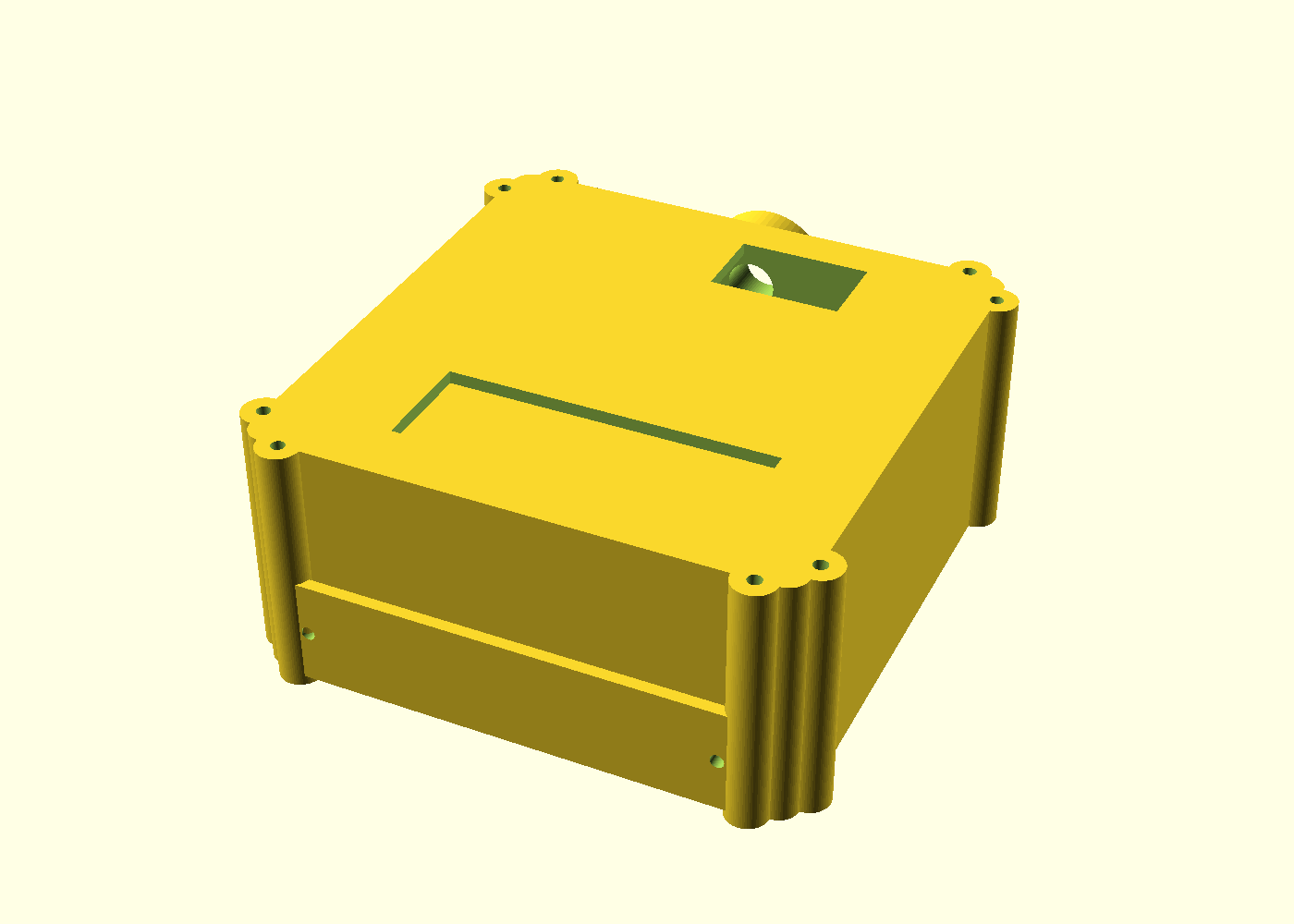
The enclosure is divided into separate electronics areas for the Geiger counter and the telemetry / battery section.
Current design features include:
- dedicated compartment for the AHGSUP / GC-1602-NANO Geiger counter module
- mounting area for a dual-18650 battery shield
- 90 mm battery-shield support rails
- mounting pads for heat-set threaded inserts
- 10 × 10 mm internal cable passages
- 11 mm external charging / power cable feed-through
- internal service bridge for ESP32 / tracker and microSD hardware
- removable beta measurement window cover
- sealing groove for silicone cord
- multiple M3 lid fastening points
- external antenna position
- reinforced suspension eye for experimental drone or rope mounting
- separate rear identification badge
Multi-color IceGeiger badge
A separate rear badge is included.
For printers with a multi-material system such as the Anycubic Kobra S1 with ACE Pro, the badge is provided as separate meshes:
- Badge Base – typically printed in black
- Radiation symbol + IceGeiger lettering – typically printed in yellow
The artwork is partially embedded into the base rather than simply being printed on top, improving mechanical bonding between the two colors.
A one-color version is also included.
Intended applications
IceGeiger can be used for portable background-radiation measurements, environmental monitoring, field surveys, GPS-tagged radiation logging, Home Assistant radiation monitoring, LoRaWAN remote monitoring, experimental radiation mapping, drone-carried measurement experiments and educational electronics projects.
Important note
IceGeiger is a DIY / experimental measurement project and is not a certified radiation safety instrument.
Calculated dose values depend strongly on the Geiger tube type, calibration factor and radiation energy. For scientific or safety-critical applications, the detector must be calibrated against a known reference instrument.
The drone suspension point is also an experimental FDM-printed structure. Always perform static load testing and use a secondary safety tether before airborne operation.
V2 – aktueller Aufbau
- GC-1602-NANO als eigenständige Geigerplattform mit Nano/LCD/Buzzer
- gelieferter HITT-Tracker V1.2 mit ESP32-S3-Familie, SX1262 und UC6580
- 2× wechselbare Samsung INR18650-25R
- integriertes duales 18650 Battery Shield, real gemessen mit 100,2 × 48,0 mm
- microSD für Offline-Routen
- WLAN/MQTT für Livewerte und Backfill zuhause
- EU868 LoRaWAN/ChirpStack für mobile Telemetrie bei Gateway-Abdeckung
- kompaktes, gedichtetes Field Case mit Beta-Fenster + Schutzkappe
Gekaufter Geiger-Bausatz
Amazon: https://amzn.eu/d/0cK2H3rO
Architektur
flowchart LR
  GM[GM-Rohr] --> GC[GC-1602-NANO]
  GC -->|INT, FALLING, Pegelteiler| T[HITT Tracker V1.2]
  T --> SD[microSD]
  T -->|WLAN MQTT| MQ[Mosquitto]
  T -->|EU868 LoRaWAN| GW[Gateway]
  GW --> CS[ChirpStack]
  CS --> MQ
  MQ --> BR[IceGeiger Bridge]
  BR --> HA[Home Assistant]
  BR --> DB[InfluxDB/Grafana]
Dokumentation
- BOM
- Elektrik
- Firmware
- Offline-Logging/Backfill
- LoRaWAN/ChirpStack
- Home Assistant
- Field Case / OpenSCAD / STL
- Assembly
- Testplan
- Kalibrierung
- Schuppenbetrieb
- Quellen
- Validierungsstatus
- Sicherheitsregeln & Strahlungsgrundlagen (Einheiten, Grenzwerte, Entladen der Hochspannung)
CAD
Aktueller Gehäuse-Druckstand: hardware/v2/field_case_v151/.
v1.5.1 integriert die Ergebnisse des ersten physischen Battery-Shield-Passformtests:
- Battery Shield 100,2 × 48,0 mm
- gemessene Lochmitten in Längsrichtung: 97,0 mm
- Auflageschienen auf 90,0 mm gekürzt; ca. 5,1 mm Endfreiheit pro PCB-Seite
- vier 10 × 10 mm Insert-Auflagen für M3-Gewindeeinsätze
- zwei 10 × 10 mm Kabelöffnungen durch die Zwischenwand
- 11-mm-Kabeldurchführung beim Shield
- verstärkte 12-mm-Aufhängeöse für Seil/Drone-Sling
- jedes Druckteil besitzt eine eigene OpenSCAD-Wrapperdatei; die COMPLETE-SCAD enthält das Gesamtmodell
ACE Zweifarben-Badge v1.5.3
Unter hardware/v2/field_case_v151/badge_v153/ liegt die aktuelle Zweifarben-Version des Rear Badges für Kobra S1 + ACE Pro:
- schwarze Grundplatte als eigener STL-Körper
- Radioaktivsymbol +
IceGeigerals eigener gelber STL-Körper - beide Körper verwenden dieselben Koordinaten für Multi-Part-Import
- fertige Multi-Part-3MF für Anycubic Slicer Next
- 0,40-mm-Verzahnung zwischen Grundplatte und Schrift/Logo
- 0,90 mm sichtbare Erhöhung von Schrift und Symbol
badge_v152/ bleibt als historischer Stand erhalten und enthält noch den supersedierten Schriftzug IceDrone.
Die älteren field_case_v14/ und field_case_v12/ bleiben als historische Stände erhalten.
Sicherheit
- GC-1602 erzeugt intern mehrere hundert Volt.
- GC-INT nie direkt an 3,3-V-GPIO; Pegel zuerst messen und teilen.
- Bei zwei 18650 vor parallelem Einsetzen nahezu gleiche Zellspannung sicherstellen und Polarität strikt beachten.
- Das Battery Shield erst nach Multimeter-/Lasttest als Lade-/Schutz-/5-V-Versorgung verwenden; Clone-Revisionen können sich unterscheiden.
- Externe 5 V nicht blind auf als Ausgang beschriftete
5V-Pads einspeisen; zunächst den vorgesehenen USB-C-/Micro-USB-Ladeeingang verwenden. - keine LoRaWAN-/WLAN-/MQTT-Schlüssel committen; siehe
SECURITY.md.